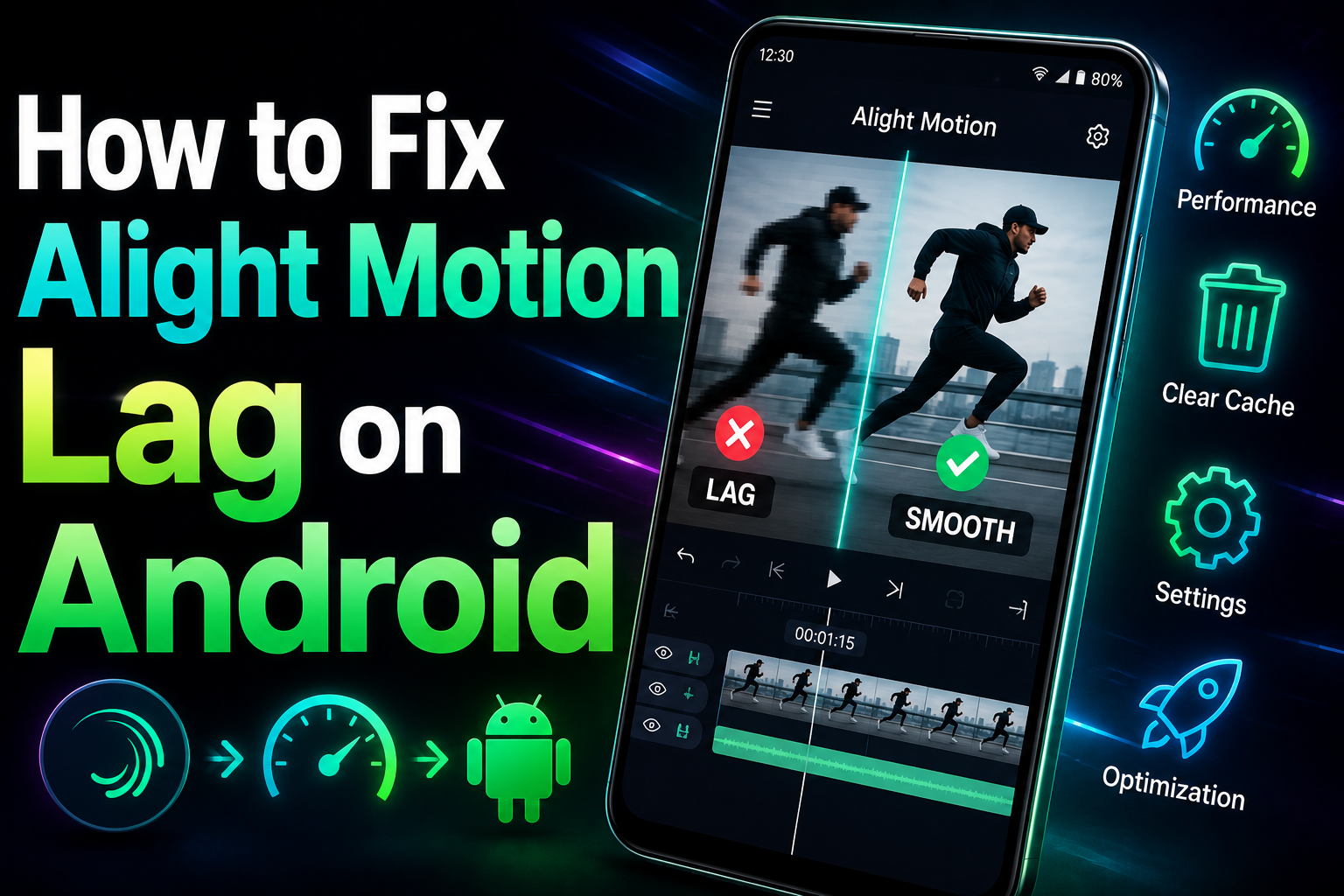
How to Fix Alight Motion Lag on Android
I was three hours into editing a 30-second clip — keyframes set, effects layered, everything looking good in the timeline. Hit play to preview. Three frames per second. A slideshow. Alight Motion had turned my phone into a PowerPoint presentation.
Alight Motion is genuinely impressive software for a mobile app. Motion graphics, keyframe animation, blend modes, multiple layers — it does things that shouldn’t be possible on a phone. But all of that comes at a cost, and that cost is performance. On mid-range and budget Android phones, Alight Motion can turn from a smooth editor into a frustrating slide show surprisingly fast.
The lag shows up in a few different ways. Sometimes it’s the preview playback that stutters. Sometimes the app freezes when you add a new effect or drag a keyframe. Sometimes everything looks fine while editing but the export takes three times longer than it should and the phone gets uncomfortably hot. All of these are related — and most of them are fixable.
I’ve used Alight Motion on a Samsung Galaxy A-series, a Xiaomi Redmi Note, and a Realme phone. Each had its own specific performance issues and needed slightly different fixes. Here’s what actually works, in order of how much impact each fix has.
Why Alight Motion Lags on Android
Alight Motion is a GPU and RAM-intensive application. When it lags, it’s because one of these resources is being exhausted — or because the app’s own settings are demanding more than your hardware can provide.
Is the lag happening in preview playback only, or also during editing (dragging keyframes, adding effects)? Preview lag = Fix 1 and Fix 2 first (preview resolution and quality). Lag during editing = RAM and background app fixes (Fix 5, Fix 6). Both happening together = start from the top and work through in order.
The Fixes — Biggest Impact First
This single setting makes the most dramatic difference for lag during playback. Alight Motion has a preview quality selector — when it’s set to “High” or “Full,” the app renders every frame at full resolution in real time. On a mid-range phone, that’s too much. Dropping it to “Medium” or “Low” for editing (you export at full quality regardless) makes preview playback dramatically smoother without affecting your final export.
- Inside your Alight Motion project, tap the settings gear icon (usually in the top right or bottom toolbar)
- Look for “Preview Quality” or “Playback Quality”
- Change it from High → Medium or Low depending on how much lag you have
- Medium is usually the sweet spot — smooth enough to see your animation clearly without taxing the GPU
- This setting only affects live preview — your export will still render at the full resolution you set for the project
- Test playback immediately after changing it — you should see a dramatic FPS improvement
If you’re working on a 1080p or 4K project on a mid-range phone, you’re asking the hardware to do a lot of real-time compositing at full resolution. A trick many motion designers use on mobile: edit at a lower resolution (540p or 720p) and only switch back to 1080p when you’re ready to export. The visual quality in the editor is nearly identical at smaller canvas sizes — and performance improves significantly.
- This is best set at project creation. When starting a new project: choose 720p (1280×720) instead of 1080p for the working canvas
- For existing projects: go to Project Settings → change resolution → note that this may affect your existing layer positioning — check your composition afterward
- Alternatively: keep the 1080p project but use Fix 1 (lower preview quality) instead of changing canvas — less disruptive to existing projects
- Final tip: for simple text or graphic animations without video clips, 720p is often indistinguishable from 1080p in the final export when viewed on a phone screen
Every active layer in Alight Motion is being composited in real time during preview. Five layers is manageable. Fifteen layers with blend modes and effects on each one is a lot to ask from a phone GPU. If your project has grown layer-heavy, consolidating layers you’ve already finalized significantly reduces the rendering workload.
- Identify layers that are “done” — you’re not going to edit them anymore
- Select multiple finalized layers → look for a “Merge” or “Flatten” option in the layer menu — this combines them into one layer that Alight Motion only has to render once
- Delete any layers you added for testing but no longer need — even invisible layers contribute to project weight
- If you have duplicate effects on multiple layers: consolidate by using a parent/group layer with the effect applied once instead of repeatedly
- Keep your working layer count under 10 for smooth performance on 4GB RAM phones — under 15 for 6GB+ phones
If your Alight Motion project includes imported video clips (not just graphics and animations), those clips are being decoded in real time during preview. A 4K video clip inside an Alight Motion project on a budget phone is a near-impossible task for smooth playback. The solution: use a lower-quality proxy version of the clip while editing, then swap it for the original before exporting.
- Before importing your video into Alight Motion: compress it first using Video Compress or HandBrake — reduce it to 480p or 720p at a lower bitrate
- Import this compressed version into your Alight Motion project and do all your editing with it
- When your edit is finalized: replace the compressed clip with the original high-quality file (tap the clip → replace media)
- Then export — Alight Motion will render using the original quality file
- This workflow feels like extra steps but saves hours of frustrating laggy editing
Alight Motion needs RAM — a lot of it. On a 4GB phone, if Chrome, Instagram, WhatsApp, and Spotify are all sitting in the background, Alight Motion gets whatever RAM is left after those. That might be 800MB–1GB on a busy system. Closing everything before launching Alight Motion gives it significantly more memory to work with and directly reduces preview lag and stuttering.
- Before opening Alight Motion: open the Recent Apps screen and swipe away every single app
- Wait 10 seconds after clearing recents — give Android time to free the memory
- Now open Alight Motion — it should claim a larger portion of available RAM
- While editing: don’t switch to other apps and come back — this partially evicts Alight Motion from RAM and can cause a full project reload when you return
- On Samsung: Settings → Battery and Device Care → Memory → Clean Now — do this before opening Alight Motion
Battery saver mode on Android cuts CPU clock speed to reduce power consumption. That’s great for extending battery life — but it’s terrible for running Alight Motion, which needs the CPU running at full speed for smooth compositing. If you edit with battery saver on, you’re essentially editing with one hand tied behind your back performance-wise.
- Pull down the notification panel → look for Battery Saver icon — make sure it’s OFF
- Settings → Battery → Power Mode (Samsung) / Battery Saver → switch to Balanced or High Performance
- On Xiaomi/MIUI: Settings → Battery → select Performance mode while editing
- On Realme/ColorOS: Settings → Battery → High Performance Mode → enable
- Important: plug in your charger while using Performance mode — it drains the battery fast
- Switch back to Balanced mode after finishing your editing session
Alight Motion generates significant temporary render files during editing. Over time — especially across multiple large projects — this cache can grow to several gigabytes. A bloated cache not only takes up storage but can slow down the app’s read/write operations during editing, contributing to general sluggishness and stutters.
- From inside Alight Motion: tap the hamburger menu → Settings → scroll down → look for “Clear Cache” or “Storage” option
- From Android settings: Settings → Apps → Alight Motion → Storage → tap Clear Cache
- Do NOT tap Clear Data — that will delete your projects and settings
- After clearing: reopen Alight Motion and open your project — the app will rebuild necessary cache files from scratch
- The first preview playback after a cache clear may be slower than usual — it’s re-caching. Subsequent playbacks will be faster
Alight Motion uses internal storage heavily during rendering — both for its own cache and for writing intermediate frames during preview. When storage falls below about 1–2GB free, this read/write performance degrades noticeably. The app starts stuttering not because it’s running out of RAM but because it can’t write temporary data fast enough. On budget phones with 32GB or 64GB storage that’s been mostly filled, this is a very common hidden cause of lag.
- Check storage: Settings → About Phone → Storage — aim for at least 2–3GB free minimum for Alight Motion
- Delete previous Alight Motion exports you don’t need anymore — these are often large (100MB–500MB each)
- Move photos and videos to Google Photos → use “Free up space” to remove local copies
- Alight Motion’s own exported files are usually saved in the gallery or Documents folder — review and delete old exports
- Target: get to 5GB+ free for comfortable Alight Motion performance on projects with video clips
Alight Motion generates more device heat than almost any other mobile app. When the phone’s temperature gets too high, Android throttles the CPU to protect the hardware — and your 30 FPS preview suddenly drops to 8 FPS. If you’ve been editing for an hour and performance has gradually gotten worse, overheating is almost certainly part of the problem.
- Remove your phone case while editing in Alight Motion — cases trap heat significantly
- Don’t edit while the phone is charging on a fast charger — charging generates its own heat that stacks with Alight Motion’s load
- If the phone feels hot: save your project, close Alight Motion completely, lay the phone on a flat cool surface (not a bed or sofa which trap heat) for 5–10 minutes
- Avoid editing in direct sunlight or in hot rooms — ambient temperature matters
- After the phone cools down: performance should return to normal. If overheating happens consistently within 20–30 minutes: the phone needs more aggressive thermal management or the project needs to be simplified (Fix 3)
Alight Motion’s developers push updates fairly regularly, and many of those updates include performance optimizations — particularly for rendering efficiency and memory management. If you’re on a version from a few months ago, you might be missing significant performance improvements. Conversely, if a recent update introduced lag that wasn’t there before, a further update may have already patched it.
- Google Play Store → search Alight Motion → tap Update if available
- After updating: clear the app cache (Fix 7) before reopening your project — old cached data from the previous version can sometimes conflict with the new one
- If performance got worse after a specific update: check reviews in the Play Store filtered by “Newest” and check r/AlightMotion on Reddit — others will be reporting the same regression if it’s widespread
- For older Android versions (Android 8 or below): some newer Alight Motion versions drop support for older APIs — you may actually get better performance by staying on an older Alight Motion version
Android has a hidden developer option that forces all UI rendering through the GPU instead of the CPU. For apps like Alight Motion that are heavily GPU-dependent, this can give a noticeable performance boost by ensuring the GPU handles all visual composition tasks rather than sharing workload with the CPU. It’s a small tweak but worth trying on mid-range phones where the GPU is underutilized.
- Enable Developer Options: Settings → About Phone → tap Build Number seven times until you see “You are now a developer”
- Go to Settings → Additional Settings → Developer Options
- Find “Force GPU rendering” → toggle it ON
- Also look for “Disable HW overlays” → toggle ON (forces GPU to handle all screen compositing)
- Restart Alight Motion and test preview performance — some phones see significant improvement, others see minimal change depending on GPU architecture
- If any other apps look glitchy after enabling these: toggle them back off — they’re not universally beneficial
“The preview quality setting inside Alight Motion is the most impactful change most people never touch. Drop it from High to Medium and a laggy slideshow often becomes smooth enough to edit properly — without changing anything about your actual project.”
Match Your Lag Type to the Right Fix
| What You’re Experiencing | Start With This Fix |
|---|---|
| Preview playback is a slideshow / very low FPS | Fix 1 (lower preview quality) — this is almost always the cause |
| Lag gets worse the longer you edit | Fix 9 (overheating) — thermal throttling builds over time |
| App freezes when adding effects or new layers | Fix 5 (close background apps) + Fix 3 (reduce layer count) |
| Export takes incredibly long, phone gets hot | Fix 9 (cooling) + Fix 3 (simplify project) + Fix 8 (free storage) |
| Lag started after app update | Fix 10 (check for newer update) — may be a known regression |
| Lag only with video clips in project | Fix 4 (use proxy clips) + Fix 1 (lower preview quality) |
| Phone has under 2GB free storage | Fix 8 urgently — storage shortage directly causes render stutters |
| Works smoothly on fresh open, slows down later | Fix 9 (overheating) — steady performance decline = thermal throttling |
| Everything slow — preview, editing, and export | Fix 6 (disable battery saver) + Fix 5 (close background apps) first |
Things That Look Like Fixes But Aren’t
Changing your export resolution from 1080p to 480p to “fix” lag is a misdiagnosis. Export resolution affects how long exporting takes, but it doesn’t fix live preview lag during editing. The preview quality setting inside Alight Motion (Fix 1) is what controls preview performance — not your export settings. Lowering export resolution costs you final output quality without actually fixing the editing experience.
Third-party RAM booster apps claim to free up memory for other apps. In practice, they free up RAM by killing background processes — then immediately use RAM themselves to run their own background service that monitors RAM usage. Net result: no improvement, sometimes a degradation. Android’s built-in memory management handles Alight Motion’s RAM needs better than any third-party booster. Don’t install these.
This sounds obvious, but when Alight Motion starts lagging, some people try adding different effects hoping a different one will perform better. Every effect you add and don’t delete adds to the project weight — even if you toggle the effect off, depending on the version. If you’re testing performance, do it on a separate small test project, not your main edit. And if a specific effect is tanking performance, the fix is usually in Fix 1 (preview quality), not switching to a different effect.
If you’re on a phone with 3–4GB RAM and a mid-range processor (Snapdragon 6-series, Helio G-series), Alight Motion will always have some limitation. With the fixes above, you can get smooth previews on simple to moderate projects — but complex 15+ layer projects with multiple video clips and GPU effects will always push budget hardware to its limits. That’s not a software bug, it’s a hardware reality. Knowing your phone’s ceiling helps you design projects that stay within it.
What Fixed the Slideshow Problem I Started With
That three-hour edit I mentioned at the top — the one playing at 3 FPS. Here’s exactly what I did, in order:
First: changed preview quality from High to Medium. Preview jumped to about 12 FPS — better but still not smooth. Second: checked storage and found I had only 800MB free. Moved some exports and photos, got to 4GB free. Preview climbed to 18 FPS. Third: turned off battery saver (hadn’t realised it was on). Preview hit 24–26 FPS — completely usable.
The core problem was three things compounding at once: high preview quality, nearly full storage, and battery saver throttling the CPU. No single fix would have gotten me to smooth playback — it needed all three together. That’s the thing about Alight Motion lag — it’s often a combination of factors, not a single root cause.
Close all background apps ✓ → Disable battery saver / enable performance mode ✓ → Set preview quality to Medium inside Alight Motion ✓ → Check storage (at least 3GB free) ✓ → Remove phone case ✓ → Don’t charge while editing if avoidable ✓. Do these before starting any complex project. They take 2 minutes and prevent most performance issues before they start.
Start with the preview quality setting inside Alight Motion — drop it from High to Medium. This single change fixes laggy preview playback for the majority of people. Then close all background apps and make sure battery saver mode is off. These three steps together resolve most Alight Motion lag on Android without touching your project at all.
If lag persists after that: check your storage (under 2GB free is a serious performance drag), consider overheating if the phone feels warm, and simplify your project by merging completed layers. And if you’re working with video clips inside your project, using compressed proxy clips during editing is the workflow change that makes the biggest difference on mid-range hardware. The phone isn’t the bottleneck — the way Alight Motion is being asked to use it is.